

What Is a Virtual Receptionist? How AI Is Transforming It in 2026
- Netregy Systems Sdn Bhd

- Apr 21
- 5 min read

Customer expectations in 2026 are higher than ever. People expect fast, seamless, and always-available responses across calls, chat, and messaging. Missed calls and long wait times often mean lost opportunities.
This shift is redefining the role of the virtual receptionist service. In this guide, we’ll explore everything you need to know about the virtual phone receptionists: what it is, different types comparison, and how AI is transforming the space in 2026.
What Is a Virtual Receptionist?
A virtual receptionist is a remote service, run by a real person or AI. It handles business communications, like calls and customer questions, without an on-site front desk.
How does the virtual receptionist work?
The remote receptionist service replaces or augments traditional receptionists by using VoIP technology. It works by routing inbound communications through cloud systems. Calls or messages are handled by trained agents or AI workflows.
What Does a Virtual Receptionist Do?
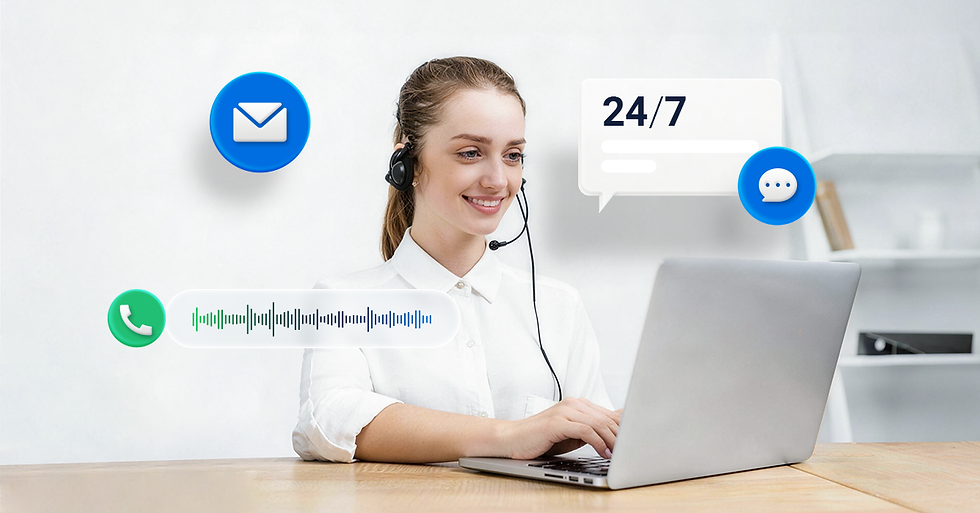
At its core, a virtual receptionist acts as your business’s front desk. It manages incoming calls and handles everyday admin tasks with professional answering services. Here are some common functions:
Live Call Answering & Routing
Answers calls in your business name and follows predefined scripts or workflows. Screens callers, identifies intent, and routes calls to the right person or
department. Urgent calls can be prioritized to avoid delays.
Lead Qualification & Intake
Collects key details such as name, company, needs, and budget. Uses structured
questions to qualify leads before passing them to sales teams, helping reduce low-
quality inquiries and save time.
Appointment Scheduling
Books, reschedules, or cancels appointments by syncing with your calendar
system. Sends confirmations or reminders to reduce no-shows and improve
scheduling efficiency.
Message Taking & After-hours Support
Records accurate messages when calls cannot be transferred and delivers them via email, SMS, or CRM. Provides 24/7 coverage with an answering service, ensuring no missed opportunities outside business hours.
Key Benefits of Virtual Receptionist Services

Never Miss a Call with 24/7 Availability
The virtual phone service ensures every inbound call is answered and captured.
Some potential customers find your website at night and call for more information. Instead of hitting voicemail, the virtual assistant answers instantly, collects their
details, and books a callback. This helps businesses avoid missed opportunities
and stay accessible to customers.
Lower Operational Costs
Compared to in-house staff, a virtual phone receptionist lowers overhead costs,
including salaries, training, and office space. It also maintains consistent service
quality. Businesses report over 60% cost savings and faster ROI by automating
routine call handling.
Better Customer Experience
Faster answers lead to higher satisfaction and retention.
There’s no doubt that most customers prefer immediate responses, and delays
often result in drop-offs. A virtual receptionist ensures every call is answered
promptly and professionally, with clear messaging and smooth routing. This
creates a strong first impression and improves overall customer experience.
Higher Lead Conversion Rates
By capturing key information and qualifying leads upfront, it quickly routes high-
intent prospects to the right team. Faster response and smoother handoff make it easier to convert inquiries into real opportunities.
Main Types: Human Virtual Receptionist vs AI Receptionist vs Agentic AI
As mentioned above, virtual receptionists have evolved far beyond traditional answering services. In the past, many businesses often confused them with Auto Attendant or IVR systems. With the rise of AI, there are now 3 new distinct options available: live human receptionists, AI receptionists, and agentic AI.
Live Human | AI Receptionist | Agentic AI | |
What | Real person answering calls remotely | AI-powered system handling calls, routing, and basic inquiries | More advanced AI that understands intent and executes tasks autonomously |
Availability | Business hours | 24/7 | 24/7 |
Experience | Highly personalized, empathetic | Conversational, instant, human-like | Context-aware, increasingly natural |
Limitation | Limited scalability, not 24/7 | Limited in complex or nuanced scenarios | Still evolving, may need setup/training |
Cost | High ($200 – $3,000/mo) | Mid (per interaction) | High setup; Variable usage cost |
Best for | High-touch service, complex customer needs | FAQs, call routing, high-volume call handling | Lead qualification, booking, workflow automation |
Who Can Benefit from a Virtual Receptionist? Industry Use Cases
Virtual receptionists are used across industries. Common use cases include:
Healthcare Clinics & Medical Practices
Front desks are often busy handling check-ins, calls, and schedule changes all at
once. A virtual receptionist service helps handle incoming calls without disrupting in-person care. Appointments get booked, common questions are answered, and overflow is managed smoothly whether through a live receptionist or an AI
receptionist. The result is a more organized front desk and a better patient
experience.
Law Firms
Calls to law firms are often urgent, but attorneys may be in meetings, court, or
focused on casework. A virtual receptionist ensures every call is picked up
professionally. It captures key details, understands the nature of the inquiry, and
helps prioritize follow-ups. Instead of interruptions throughout the day, legal
teams can stay focused and respond to well-organized, high-intent inquiries.
Real Estate Agencies
In real estate, timing can make or break a deal. A potential buyer calls about a
listing, but the agent is busy with a showing or on the road.
A virtual receptionist steps in the moment the call comes through. It greets the
caller, captures their interest, and routes the lead appropriately. This keeps
prospects engaged right when interest is highest without relying on callbacks.
Home Services (HVAC, Plumbing, Cleaning)
For home service businesses, calls often come in while technicians are already on-
site. If no one answers, that job may never come back. A live receptionist handles
bookings and inquiries in real time, ensuring customers can schedule services right
away. Technicians stay focused on their work while new business keeps coming in.
E-commerce & Retail Businesses
Customer inquiries don’t stop after hours. People reach out about orders, returns, or product details whenever it’s convenient for them.
The virtual answering service keeps those conversations going 24/7. Common
questions are answered instantly, and only more complex issues are escalated.
Support teams start the day with active, organized conversations instead of a backlog.
Limitations of Virtual Receptionist Services
Traditional virtual answering services have played an important role in helping businesses manage calls. However, they also come with clear limitations:
Human Error: Live agents can misroute calls, miss messages, or make mistakes.
Limited Multichannel Support: Traditional receptionists usually handle only phone calls, not chat or messaging.
Training and Onboarding Needed: New agents require time to learn your workflows and protocols.
Slow Response to Volume Spikes: High call volumes can cause long wait times or dropped calls.
This is where the AI receptionist is redefining the game.
Unlike standard answering services, AI-powered receptionists:
Understand caller intent in real time.
Automate workflows for lead capture, appointment scheduling, and routing.
Deliver consistent, 24/7 service at scale without delays or errors.

Meet Yeastar AI Receptionist: Your 24/7 Smart Virtual Phone Receptionist
To support this transformation, solutions like Yeastar’s AI Receptionist are designed to drive more business with a smart voice AI agent. With this solution, your virtual receptionist service becomes an always-on, human-like assistant.
What Makes Yeastar AI Receptionist Different?
Always-On, Human-Like Service: Acts as a virtual phone receptionist for calls, messages, and inquiries across all locations, ensuring no opportunity is missed.
Multilingual & Brand-Aligned: Supports 34 languages and understands your company profile, providing consistent, professional, and localized interactions.
Smart FAQs & Intelligent Call Routing: Resolves common questions instantly using your knowledge base and routes calls to the right team or extension with precision.
Context-Aware Conversations & Insights: Leverages Natural Language Processing(NLP) to understand caller intent, while detailed call reports and analytics help optimize your AI virtual receptionist performance.
Quick Setup & Cross-System Automation: Deploy in minutes with zero coding, and integrate with CRM or other business systems to automate scheduling and workflows.
Final Thoughts
The virtual receptionist is no longer just a support function, it’s becoming a critical part of how businesses capture demand and deliver customer experience.
With the rise of AI, businesses can now move beyond basic answering services to intelligent, automated, and scalable communication systems. In 2026, the question is no longer whether you need a virtual answering receptionist, but whether your solution is smart enough to keep up.


Comments